

When you need to identify and measure charged particles in a liquid, ion chromatography offers a precise solution. It separates ions based on how strongly they interact with a special resin inside a column cation and anion analysis, letting you distinguish one from another. Understanding how this separation happens and how the results reveal concentrations can change the way you approach analyzing water or environmental samples. But what exactly happens inside the column to make this possible?
What Is Ion Chromatography and What Does It Measure?
When analyzing the composition of liquids, ion chromatography helps you separate and measure ions and polar molecules efficiently. This technique targets charged particles, like anions and cations, that are crucial in understanding water quality, pharmaceuticals https://laballiance.com.my/, or environmental samples. You get precise insights into substances such as chloride, nitrate, sulfate, sodium, and potassium. Ion chromatography measures their concentration, giving you the freedom to make informed decisions based on accurate data.
This method is powerful because it handles complex mixtures without destroying the sample, letting you maintain control over your analysis. Whether you’re monitoring pollution or ensuring product purity, ion chromatography offers a reliable, straightforward way to quantify ions and polar molecules, empowering you to explore and manage liquid compositions with confidence.
How Does Ion Chromatography Separate Ions in a Sample?
Understanding what ion chromatography measures sets the stage for exploring how it actually separates ions in a sample.
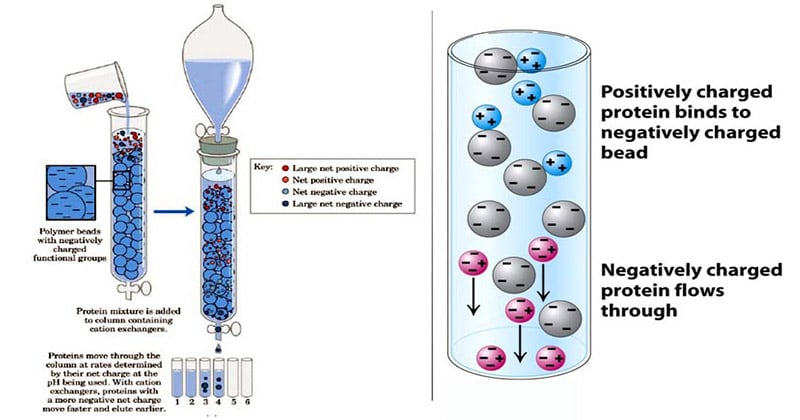
You’ll find that the heart of the process lies in the interaction between ions and a special resin inside a column. As your sample flows through this column, ions compete to attach to the resin based on their charge and size.
Those with stronger attraction stick longer, while others pass through faster. This difference in retention times lets you distinguish and separate them effectively.
What Equipment and Materials Are Needed for Ion Chromatography?
To get started with ion chromatography, you’ll need several key pieces of equipment and materials that work together to analyze your sample accurately.
First, a reliable ion chromatograph acts as the heart of the system, handling separation and detection. You’ll also need high-purity eluents, which are the liquids that carry your sample through the column. Finally, columns packed with ion-exchange resins provide the surface where ions separate based on their charge and size.
- Ion chromatograph with integrated detector
- High-purity eluents or mobile phase solutions
- Ion-exchange columns specific to your target ions
With these essentials, you maintain control over your analysis, ensuring precision without constraints. This setup lets you explore samples freely, confident in your results.

How Do Scientists Interpret Ion Chromatography Results?
Interpreting ion chromatography results lets you identify and quantify ions in your sample by analyzing the chromatogram peaks. Each peak corresponds to a specific ion, and its retention time helps you determine which ion it is, based on a reference standard.
The peak’s height or area reflects the ion’s concentration, so by comparing these to calibration curves, you can measure exactly how much of each ion is present. You’ll also check for peak shape and resolution to ensure accuracy—sharp, well-separated peaks mean reliable data.
If peaks overlap or distort, you might need to adjust your method. By mastering this interpretation, you gain the freedom to confidently analyze complex mixtures, making ion chromatography a powerful tool for your investigations.
Why Is Ion Chromatography Important for Water and Environmental Testing?
When testing water and environmental samples, ion chromatography plays a crucial role in detecting contaminants and ensuring safety.
You rely on this technique to identify harmful ions quickly and accurately, giving you control over the quality of water and the surrounding environment.
It helps you:
- Monitor pollutant levels to prevent health hazards
- Ensure compliance with environmental regulations
- Protect ecosystems from toxic chemical buildup
Conclusion
Now that you understand how ion chromatography separates and measures charged particles, you can see why it’s essential for analyzing water and environmental samples. This precise, nondestructive method lets you identify and quantify ions quickly and accurately, helping protect public health and the environment. Whether you’re testing drinking water or monitoring pollution, ion chromatography gives you reliable results you can trust every time.